

By Siobhan McDevitt, L.M.F.T. Licensed Marriage and Family Therapist/Core Class Facilitator and Carol Castanon, Child & Family Consultant, Former Director of Secure Beginnings
Newborn: 0 to 3 months
This stage is the beginning of the infant-parent relationship. While the prenatal experience has influenced child, mother, father and caregiver in many ways, sometimes profoundly, it is with the arrival of a child that the work of relationship unfolds. The newborn is working on being attached with the basic trust that all their needs will ultimately be met with immediacy. This is the stage of building trust in their belly, skin, brain and nervous system.
From the beginning, let your newborn know the plan. Talk to them about diapering, feeding, holding and soothing. New babies sleep a surprising amount of time, sometimes up to 16 or 17 hours a day. However, newborns will typically wake every 2 to 4 hours for feeding, connection and comfort. An exhausted parent may find they’re waiting for their new little one to wake up, delighting in this new human and seeking the reassurance of a well baby.
Newborns are learning about the world through all their senses, and they are learning about themselves too. The world of the newborn is close at hand. It is touch and taste, sight and sound within the proximity of another’s arms. Some newborns will gaze towards objects in the distance, but many will be looking closely for eye contact. Too much stimulation and baby turns away or has fast breathing, maybe puts hand to mouth and is measuring the amount of stimulus comfortable in their ever so tiny bodies. Noises may startle newborns and you’ll witness a quick physical jerking response.
Newborns cry. Some cry more than others and some days are better than others. Your baby is communicating just the way they know how. The best way to help a newborn is to be available, empathetic, and calm. It’s important for mothers and fathers to get the support they need during the first three months. This is a time for helping hands. Parents are learning to understand this new person’s cues, both comfort, and discomfort. Engagement cues, or I need you, include staying still, turning toward and gazing at “your” face (en face), smooth arm and leg movements, and cooing sounds. This is the time of deep co-regulation or calming of baby by mother, father, or other caregiver. Often, baby needs mother most for calming. And, mothers may be healing from pregnancy and birth. Fathers or other partners are now able to feel physical connection through touch, eye contact, voice and motion. Caregiving requires stamina, inquiry, and perseverance. Parents are learning about their capacity and flexibility.
For the newborn, night and day are the same as they are new to the rhythm of light and darkness. Night sleep times usually stretch to “longer than day sleep” about 6 to 8 weeks. Newborns eat, cry, sleep, and poop in a dizzying order as their body adjusts to milk, nipples, diapers, clothes, air, water and skin. Their job is to be seen and heard, to survive, to experience their body and others, and to learn about love.
Infant: 4 to 12 months
At about 4 months of age, most babies begin to smile on volition, laugh, gaze with reciprocity, and refine their cues. Parents have been practicing the fullness of parenthood. Communicating with your baby can be playful, but it’s also important in building a partnership in the caregiving needs of a baby. Remember to let baby focus on their body, and their environment. And, when there are needs to be met or places to go you include this in your conversation with baby.
Parents might now understand the different cries, feeding schedules, and sleep patterns of their new baby. Parents can anticipate the many needs of this new being, and might even begin to restore their energy output of the first three months. Babies have experienced enormous growth since birth. In fact, a baby may double their weight by 5 months.
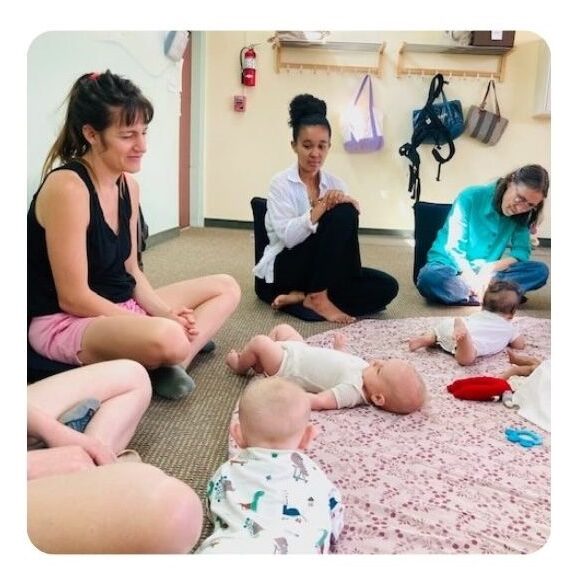
A baby’s core strength is increasing and you may notice movement toward rolling over from back to tummy. Tummy time is more comfortable and enjoyable for babies who can roll from back to tummy, hold their head up, and roll again to back time. They will begin to kick their arms and legs with intention and with pleasure.
Trust your baby to know what their bodies are ready for. Most of the time, a baby’s stage of development can’t be rushed or taught. Parents may be eager for their babies to do more, but let your baby guide you on their readiness, and trust that they are doing just what they need to do for their physical and cognitive growth.
At 8 months, a baby may experience a noticeable reaction to separation, or interaction with others. There are many times throughout the 0-3 years where there is tension around separation and attachment. As the first 12 months progress, and weight triples from birth, you will witness rolling, sitting, crawling or walking. As baby learns new skills, there is often an emotional reaction that includes joy as well as tension, and you might see this in separation.
During the first year, a baby begins to understand certain words and phrases. Their ability to explore the environment is quick and hands-on. This is a time to keep your baby in clothes that are comfortable and made for movement, not restriction. It is also when baby proofing is essential for safe baby. It helps to create at least one space which both you and baby can count on to be infant toddler appropriate! Parents begin to have a real and visceral sense that their infant is becoming a young tot as the first year inches to the next.
Baby to Toddler: 12 to 24 months
With baby’s first birthday, many parents and caregivers feel a sense of accomplishment, relief, and joy after their first year together as a family. Baby may have spoken a first word or taken a first step. By this time, patterns have emerged so that feeding, diapering, sleeping and playing times are somewhat predictable. Daily routines have often been established. Family life has settled into a rhythm.
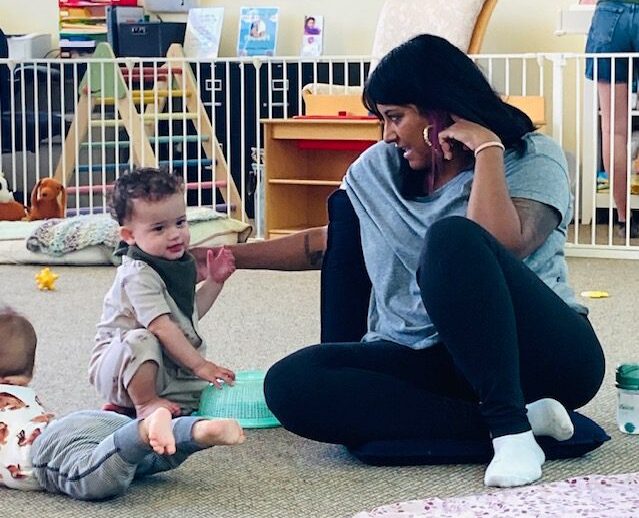
During the second year, however, the profound growth in the baby and young toddler often means adjusting to a bolder, busier rhythm, especially as children learn to move – crawling, standing, and walking! Sleep patterns can change as the child’s whole being practices these new movements. Sometimes in their second year, babies give up their morning nap and spend longer periods of time awake, playing and moving. The baby-in-arms becomes a baby-in-the-world!
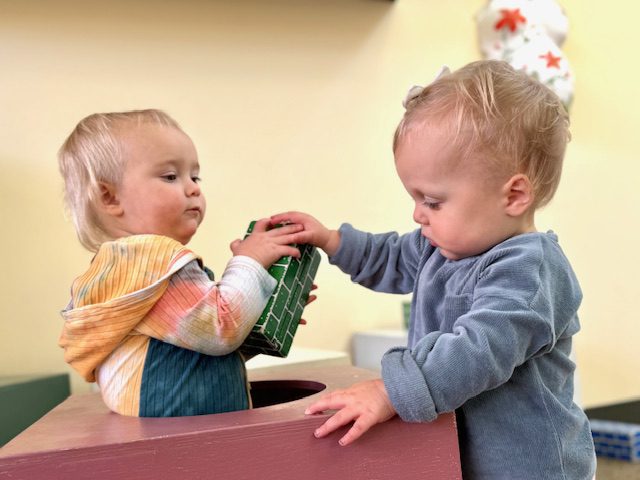
With this ability to move independently comes a sense of autonomy. The baby and young toddler becomes curious about “all by myself.” Social exploration with other babies and young toddlers may involve grabbing, holding on tight, or saying, “No!” with words or body language. These are ways for young children to assert their space and place in the world. Grownups can stay close by, ready to support the tears, tantrum, biting, or hitting that may accompany these big feelings. Adults can say, “I see your tears and you look frustrated.” Hugs and comfort are much needed even though baby is moving more independently.
Adults often overestimate a toddler’s capabilities as they transition out of infancy, and underestimate a toddler’s inner competencies. Toddler autonomy is never really “by myself” but is an inner self-confidence that develops with caring adults who allow children to safely explore (physically, emotionally, socially) while being ready at a moment’s notice for reassuring words, eye contact, and touch.
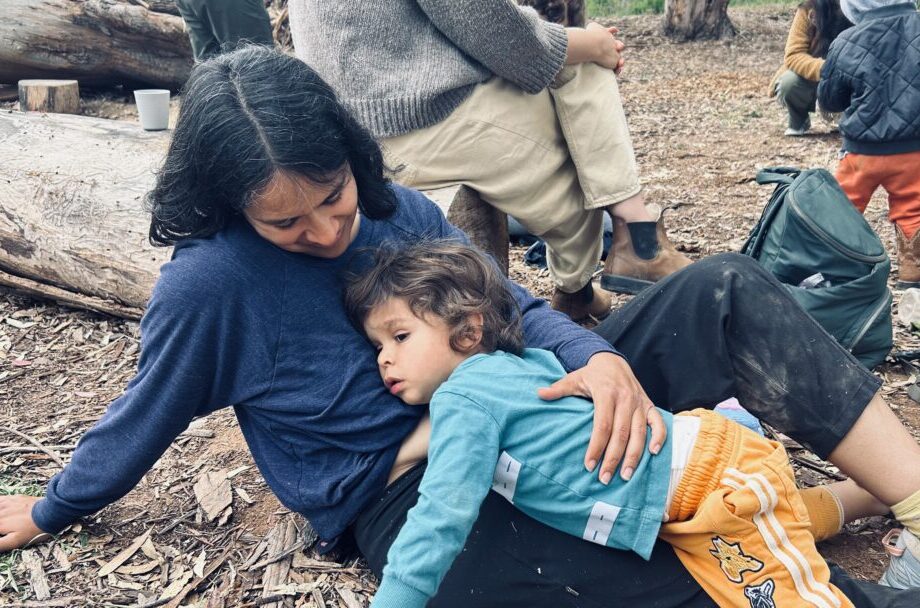
No matter how confident – even bold! – your toddler seems, they will be anxious or afraid sometimes. Toddlers need to balance their growing need for exploration with their need to be safe. Toddlers may want a longer snuggle or gather more comfort objects before bedtime. They may depend on familiar rituals such as the same book or the same song at bedtime. These are ways for toddlers to have control in a world that is much bigger than they are.
As they develop more and more physical mastery, babies and young toddlers test limits of their behavior. Testing limits of what is okay and not okay is one way that babies learn to feel safe with their grownups. Adults are called upon to be very patient, clear and consistent. Power struggles may develop around diapering, feeding, sleep, and transition times. Allow plenty of time for transitions. Sometimes a simple choice is helpful, such as “It’s time for a diaper change. Would you like to fasten your diaper or would you like me to do it?”
The second year is a remarkable time for language development. Babies often use between 50 to 150 words by eighteen months and may speak in simple sentences
such as, “I thirsty.” Although they understand and speak more and more, babies and young toddlers only grasp what’s now and next. Clear communication about now and next helps settle daily life and support language development. Very young toddlers often speak about what is right in front of them. Adults can put words to experience by saying things like, “You’re rolling the ball” and “Now we are putting toys away, and then it’s naptime.”
Play is a child’s work. You may see children this age pour, dump, squish, scoop, squeeze, stack and knock down. It may seem that baby is doing the same thing over and over again. Parents sometimes wonder whether this is normal or how they can encourage their child’s learning at this age. The most basic ingredient for baby’s healthy learning is a warm, reliable, protective relationship with their grownups. Babies learn best when they are calm, relaxed, safe, and loved. The most important things adults can do to support baby’s learning are to talk, read, sing, go for walks, and simply enjoy one another.
Toddler: 24 to 36 months
This stage of development can often bring new challenges in the parent child relationship. Toddlers are fast, bold and opinionated. Curiously, while they are finding their voice in the world, a tot may also be shy in the company of others. A parent may want their child to be “friendly or respectful” to others, and cooperate at home. A tot might seem developmentally ready for this expectation as they are now childlike, less like a baby physically and biologically. Toddlers this age seem to understand everything.
Some toddlers have developed a broad expressive vocabulary by 24 months, and by 36 months are mostly quite fluent with language. In fact, a bi-lingual child might be able to speak 2 languages well by their third birthday! But, don’t let language fool you. Toddlers are very young and immature socially and emotionally, with one foot in their babyhood and one foot in the world of a very young child. Just yesterday they were babies.
This is the age of tot decision making. What feels hard for the adults is often about autonomy for the toddler. Giving choices may be very helpful. For example, you can hold this hand or this hand when we cross the street. Too many choices may overwhelm a toddler. Your toddler may cry, yell, and even have biting feelings. Their work is navigating autonomy with very strong feelings while in the company of a new and demanding world. Parents might ask their toddler to wait more, use the potty, play near others, and be part of meals for a longer span of time. The parent is ready for a more concrete partnership, and the toddler is ready to control their world.
Transitions may take a very long time for your tot. They often do at this age. It helps to make transitions part of the schedule of the day, and not what happens in-between daily events. Transitions become the event. Being playful, very calm, and having routines are
good parent tools during the mid to late tot stage. Attachment is particularly important to notice. Is this behavior about wanting or needing their parent? Although toddlers may have a well developed vocabulary, they may be very non-verbal about getting you! They may love to read stories about the potty, or waiting, or going away and coming back, or pets, or….
Toddlers love to sing and be sung to. Hand motion songs are very enjoyable. In fact, songs can be helpful during moments that seem hard to navigate. Toddlers are learning about friends. Toddlers love to be with other children, but will mostly still play near and not with others. Although, playing with older children may look more successful, it is mostly the older child who is able to show ingenuity and flexibility. Toddlers are learning about both waiting for a toy and being all done with a toy. They need clear messages and choices. Toddlers this age will still need a nap, but napping may get harder as they are so busy playing. This age likes to run, climb, paint, and squish. Toddlers call on their grown ups to be captain of the ship, compassionate, reflective, and very present.
Three Years Old
Often a child’s third birthday brings a period of calm after a tumultuous two-year-old period. The three-year-old child has grown in brain, body, and heart, and families often enjoy an increased partnership with this young child who thinks, speaks, moves, and feels with a new sense of power. Three-year olds may run, hop, balance, sing and draw with force! They learn by exploring with all their senses. They may also work more cooperatively with their adults to perform daily tasks such as setting the table, scooping pet food, or putting toys away. Three-year olds can be joyous, cuddly, imaginative and playful. They can also be worried, and sometimes more tearful than they were when they were two. Depending on their own temperament, some parents will find these ups and downs more difficult to navigate than previous developmental stages.
Three year olds can be full of contradictions and surprises as they make sense of the world and their place in it. The maturity that comes with cognitive, physical and emotional growth brings the child some fear and anxiety about his or her fantasies and feelings. Children who are three might worry about their own strength – no longer babies, they relish in the power of their bodies, but may worry about being too strong, too powerful, or too rough. The child’s growing awareness of his or her aggressive feelings might be acted out in play – scenarios involving superheroes, dinosaurs, wild animals or emergency rescues may develop. Or they may wake from scary dreams and need help getting back to sleep. It helps to limit media time, especially any games or programs that are dramatic, stressful and scary, even if your child seems fascinated by them.
Adults can help children manage big worries by staying close. Sometimes it is helpful to give brief, accurate information such as, “You are bigger and stronger than you were when you were a baby, and I am still here to keep you safe.” Young children need to know that even their biggest, boldest moves won’t push their grownups away, physically or emotionally.
Because a child’s imagination blooms during this time, you may notice him or her watching and observing people more closely. These observations will probably be reflected in the child’s play. An imaginary friend may become part of the child’s rich fantasy life. As the child’s imagination grows, so does a sense of humor and empathy. Children may show interest in a crying baby, for example, or a friend with a skinned knee. They may even rush to get a toy or bandage to help soothe and comfort.
By now, the three-year old may feel that he or she can do more “all by myself” and they should be given plenty of chances to practice bouncing a ball, pedaling a trike, or hopping on one foot. They may become frustrated when adults don’t let them do something on their own. Conflicts around toileting, mealtime, and sleep may persist. When safe and appropriate, adults can support the child’s growing autonomy by providing simple choices such as which cup they would like to use and then allowing the
child to take the cup from a low shelf. Children learn about themselves and the world by trying and doing for themselves with adult companionship and support. Just be sure to plan for the extra time it takes to visit the bathroom, prepare a snack or clean up with a three-year old!
In the third and fourth years, friendships become more and more important. Children this age will laugh loudly, cry hard, and hug tightly with one another. Adults can encourage these important relationships by establishing playtimes with other children and families. Together, children learn how to relax, share, play, solve problems, and grow into the world.